
Last updated September 10, 2026
Full 25-point door and opener safety check with every visit - springs, cables, rollers, tracks, and your LiftMaster or Chamberlain opener included
You get a price before we start. It does not change when the truck arrives.
 Before
 After
After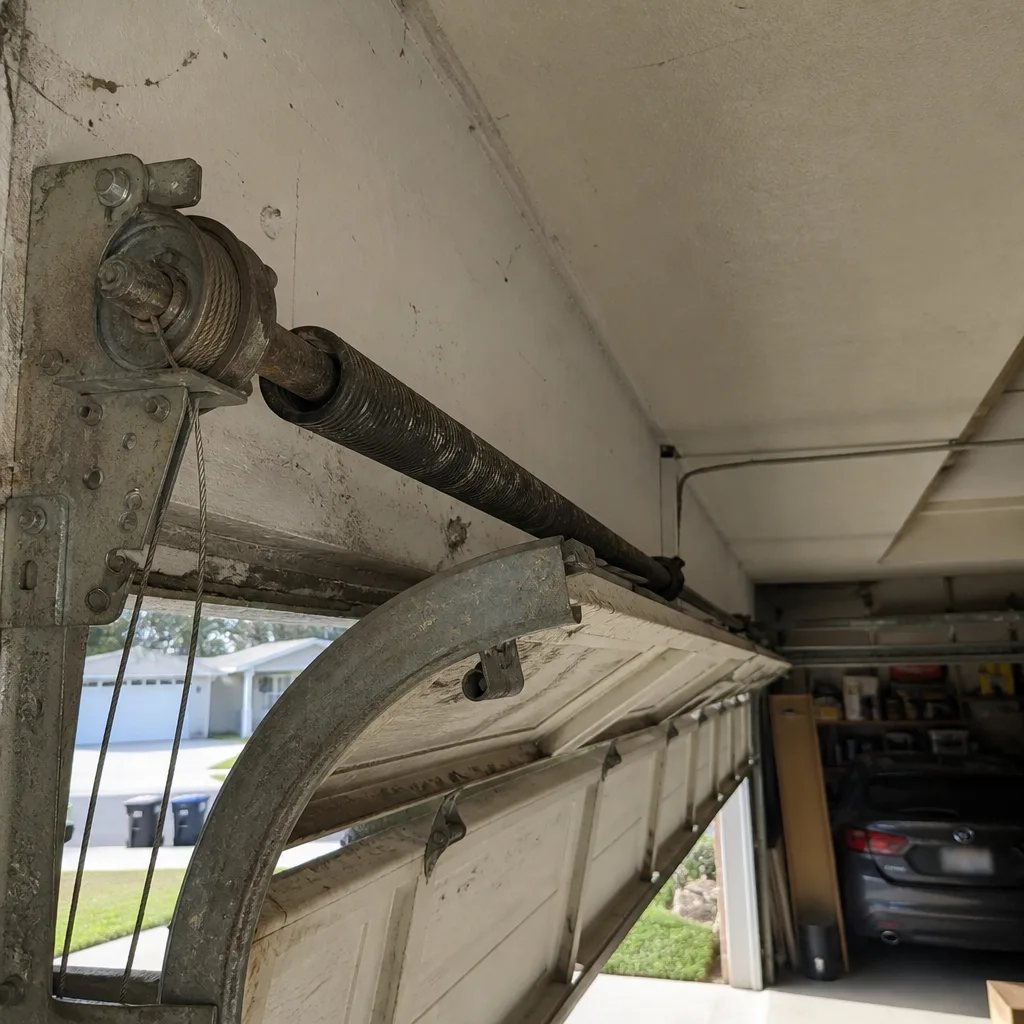 Before
 After
After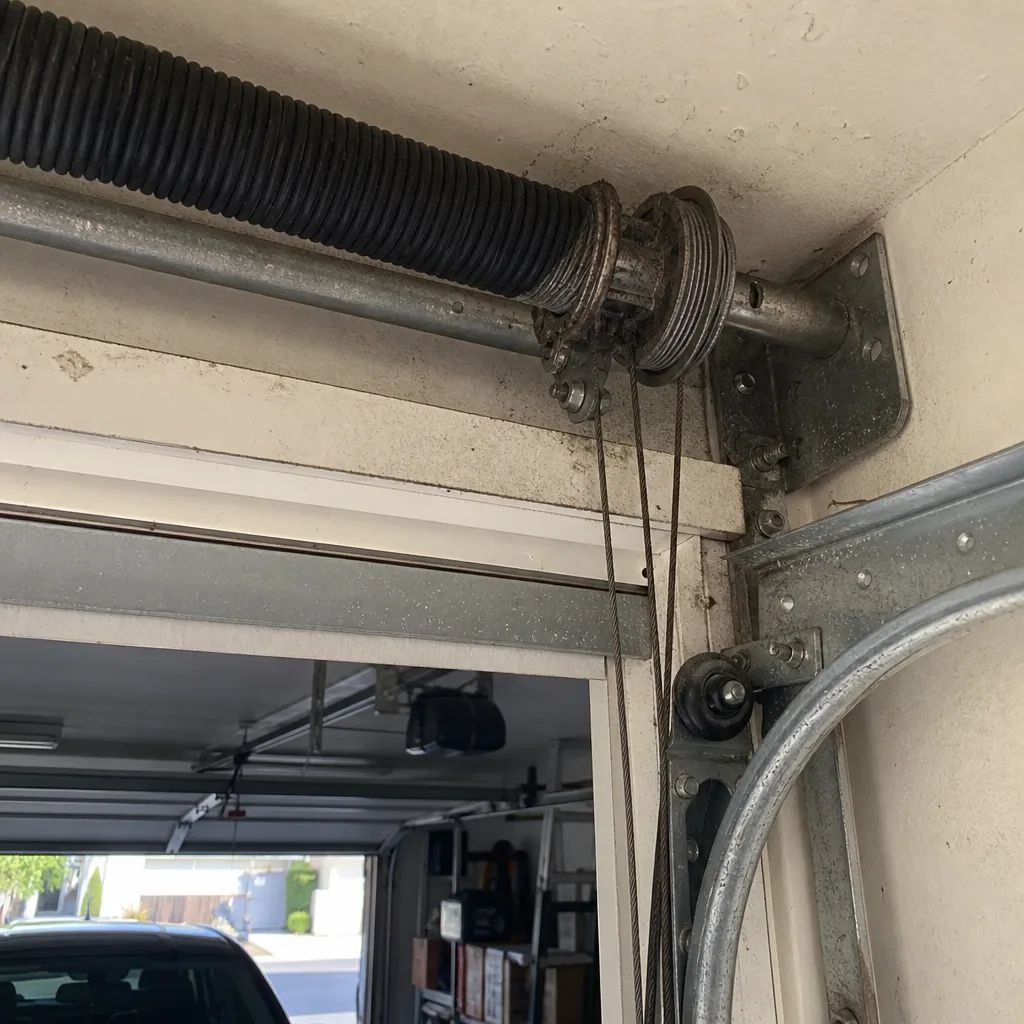 Before
 After
AfterDIY vs Professional Garage Door: The Huntington Beach Homeowner’s Decision Guide
A garage door torsion spring stores roughly the same energy as a car traveling 30 mph. The number of YouTube videos that casually walk you through adjusting one without mentioning that a slip can send the winding bar through your forearm is genuinely alarming. This guide is not going to do that. We’re going to draw a clear line between what a careful Huntington Beach homeowner can safely handle on a Saturday morning and what deserves a call to someone who does this every day. You’ll learn the physics, the real costs, the warranty traps, and how to tell what kind of spring system your door actually has before you touch anything. For more guides & resources, see our blog.
Quick Answer
For Huntington Beach homeowners, the DIY vs professional question comes down to one distinction: tasks involving high-tension springs, cables, and track realignment are professional jobs with real injury risk, while lubrication, weatherstripping, sensor alignment, remote reprogramming, and minor dent repair are safe DIY territory. Expect to pay roughly $180 to $340 for a pro spring replacement versus risking a hospital bill or a botched job that doubles the repair cost later. When in doubt, call a local shop like Otto’s Garage Door at (714) 650-8648 for a straight answer before you touch anything under tension.
Table of Contents
- What You Can Safely DIY: Five Tasks That Don’t Require a Pro
- What Needs a Professional: The Physics of Tension
- How to Tell If You Have Torsion Springs or Extension Springs
- The Hidden Cost of a Botched DIY Repair
- Cost Honesty: When a Pro Call Is Worth It and When It Isn’t
- Huntington Beach Specific Factors: Salt Air, Heat, and Code
- Common Mistakes to Avoid
- When to Call a Professional
- Frequently Asked Questions
What You Can Safely DIY: Five Tasks That Don’t Require a Pro
Here’s the honest truth from twenty-plus years of running a garage door company in Huntington Beach: there are plenty of things you can do yourself without touching anything dangerous. In our experience, homeowners who handle these five tasks properly see smoother operation, fewer noises, and longer door life. For the full list, see our Garage Door Repair Maintenance Checklist for Huntington Beach Homeowners. None of these involve the springs. That’s the line. Here’s exactly what to do.
- Lubrication. Your door has hinges, rollers, and a track that need attention every six months. Buy a lithium-based grease for the hinges and a silicone spray for the rollers. Do not use WD-40; it’s a solvent, not a lubricant, and it will strip what little grease remains. Apply grease to the hinge pivot points and silicone to the roller bearings. Takes twenty minutes, costs under $15, and it’s the single most effective thing you can do to prevent a service call.
- Weatherstripping replacement. The rubber seal along the bottom of your door cracks and hardens in the Huntington Beach sun within two or three years. A new one costs about $20 to $40 depending on your door width. You slide the old one out of the retainer track and slide the new one in. No tools required beyond a pair of scissors and maybe a flathead screwdriver to coax it through.
- Sensor alignment. If your door reverses for no reason, the photo-eye sensors at the bottom corners have likely vibrated out of alignment. Loosen the wing nut on the sensor bracket, adjust until the small indicator light glows steady green or amber, tighten. That fixes roughly one in four “broken opener” complaints we get in Huntington Beach before we even send anyone out.
- Remote reprogramming. When a remote stops working, nine times out of ten it’s a dead battery. The other one time, it lost its code. Your opener’s manual has the exact button sequence. Most brands, including Genie and Wayne Dalton models, use a “Learn” button on the motor unit. Hold it, press the remote button, done. If you don’t have the manual, the model number is printed on the motor housing and the PDF is online.
- Minor panel dent repair. Huntington Beach garages take hits from bikes, surfboards, and the occasional over-enthusiastic trash can. Small dents in aluminum or steel panels can sometimes be worked out from the inside with a rubber mallet and a block of wood. This is cosmetic; nicks and small dents don’t affect function. If the panel is creased or the dent breaks the paint on a steel door, leave it alone and call us before rust sets in.
None of these tasks require tools beyond what’s in a basic homeowner kit. None of them put you near a spring under tension. If a task is not on this list and it involves a metal part that snaps or pops, stop and read the next section.
What Needs a Professional: The Physics of Tension
A garage door weighs between 150 and 250 pounds depending on the material. The springs are what make that weight feel like nothing when you lift it. They’re wound tight. Really tight. A standard torsion spring on a two-car Huntington Beach door is under anywhere from 7 to 9 turns of tension, and each turn stores energy. When that spring snaps, the released energy is comparable to a small explosion. That’s not dramatic language; it’s the physics that put thousands of people in emergency rooms every year.
Here are the three tasks where we tell every homeowner the same thing: do not do this yourself.
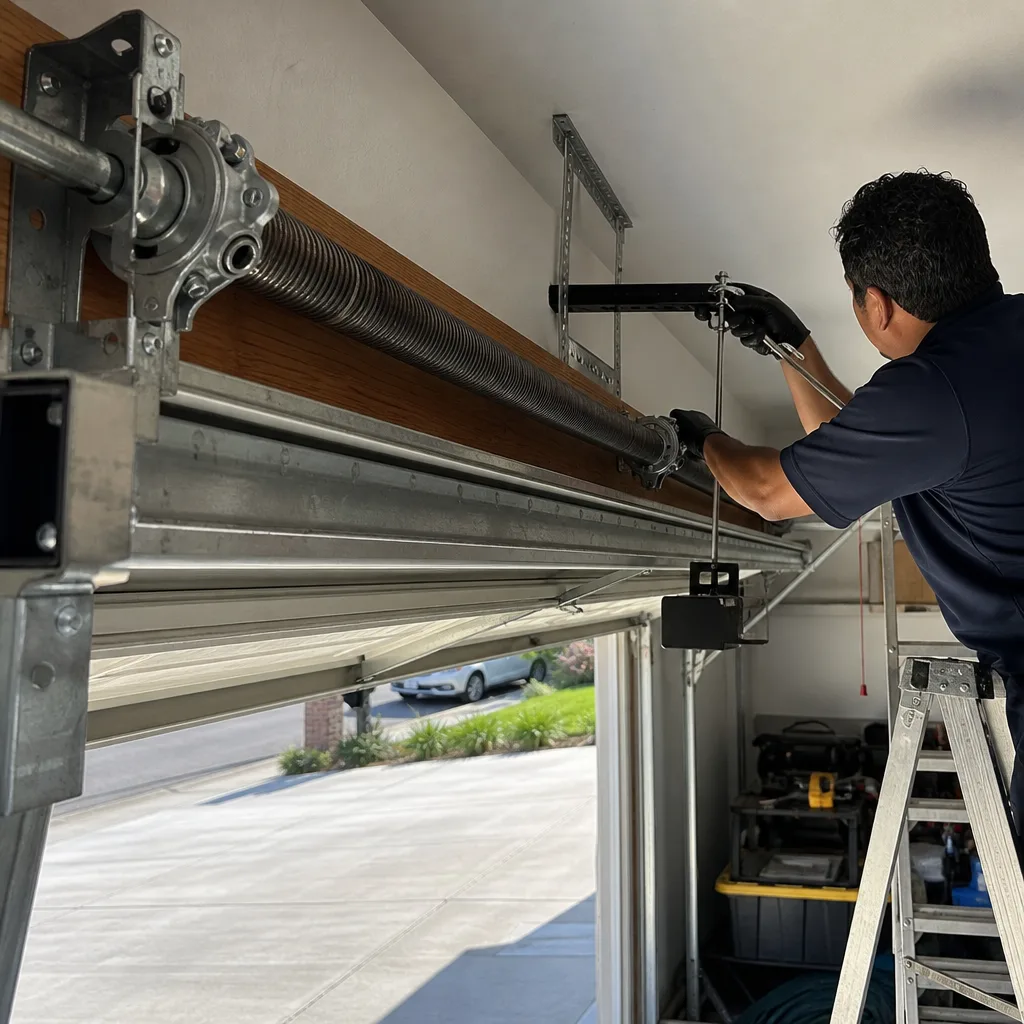
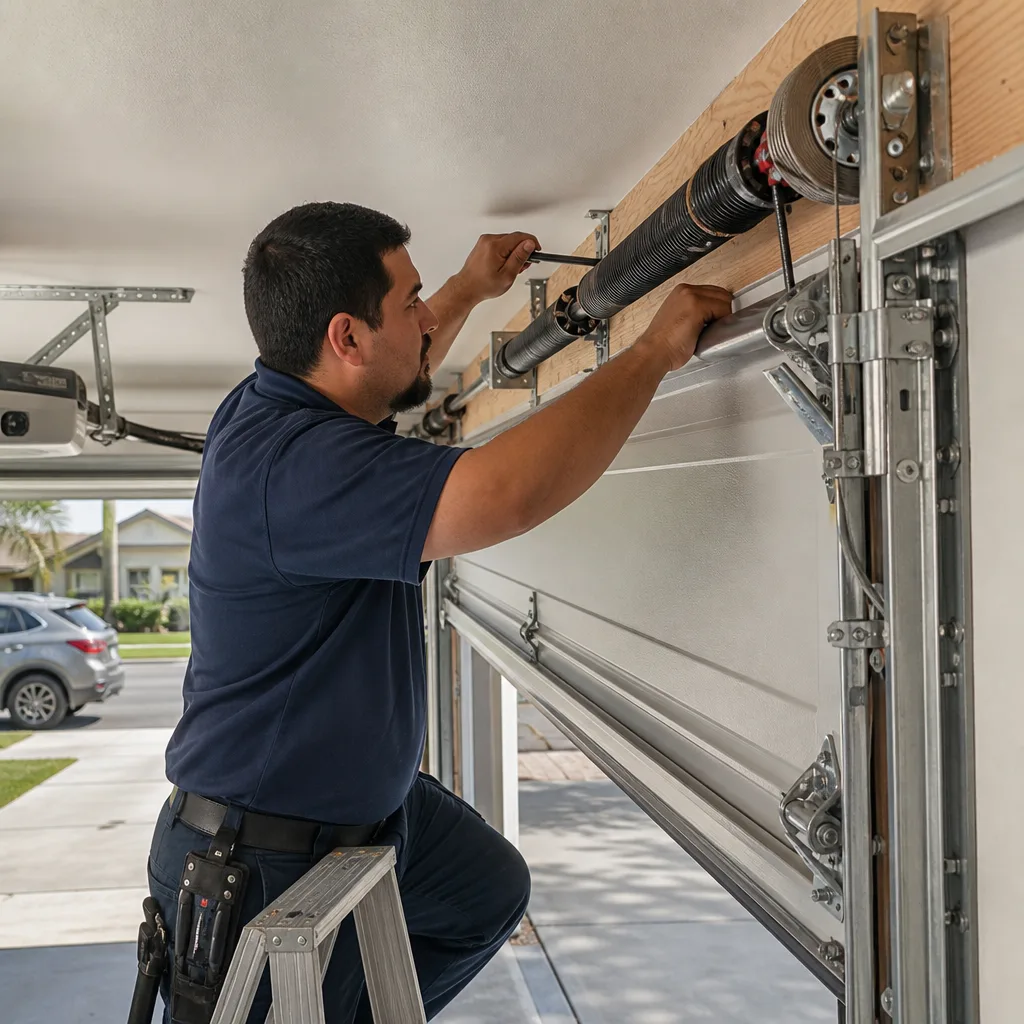
- Torsion spring replacement. The spring sits on a metal shaft above the door. To replace it, you need winding bars, not an adjustable wrench. You need to know the correct number of quarter-turns for your door’s weight and height. You need to keep your body out of the winding bar’s path at all times. The winding bar is a two-foot steel rod. When a spring slips, that bar moves with the full force of the stored energy. It goes through drywall, through car windshields, and through forearms. We’ve seen the aftermath. It’s not worth it.
- Cable rewinding or replacement. The lift cables run along each side of the door and wrap around drums at the top. They’re under the same tension as the springs. If a cable has come off the drum, something caused it, and that something is usually a spring issue or a broken component. Putting the cable back on without addressing the cause means it comes off again, and when it does, the door can drop suddenly. A dropped 200-pound door clears the space under it in under a second.
- High-tension bracket work. The bottom brackets that hold the lift cables are under constant load. If they’re loose or corroded, the entire cable assembly can fail without warning. Working on these brackets without releasing tension from the system is asking for a cable to whip across the garage.
We’ve said it a hundred times in Huntington Beach garages: a door is 200 pounds riding on two springs. Respect it. The person who installed it spent years learning to do it without getting hurt. You watched three videos. That gap is real, and it’s measured in hospital bills.
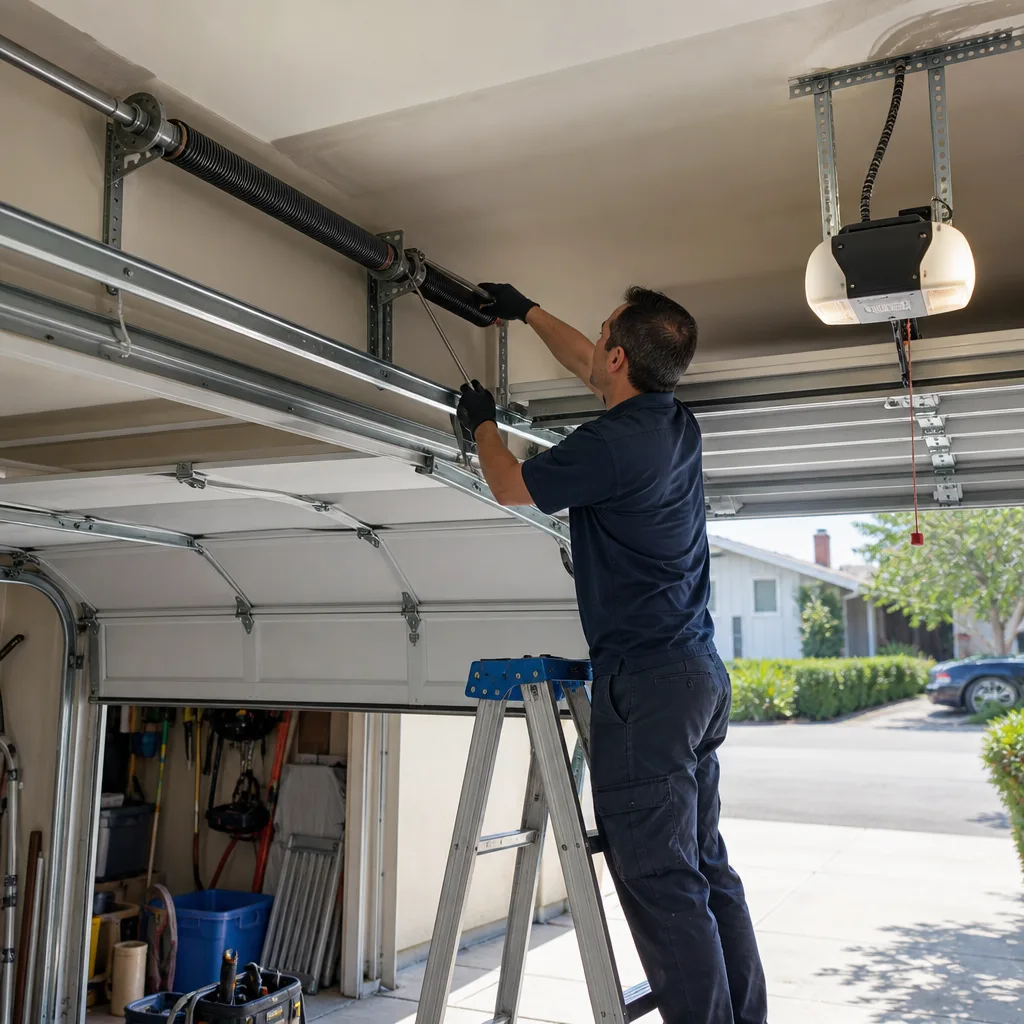
If your spring is broken, the right move is to call Garage Door Repair in Huntington Beach and let someone who does this daily handle it. The cost is a fraction of what an ER visit runs.
How to Tell If You Have Torsion Springs or Extension Springs
Knowing which spring system your door uses matters because the risk profile is completely different between the two. Here’s how to identify yours without touching anything.
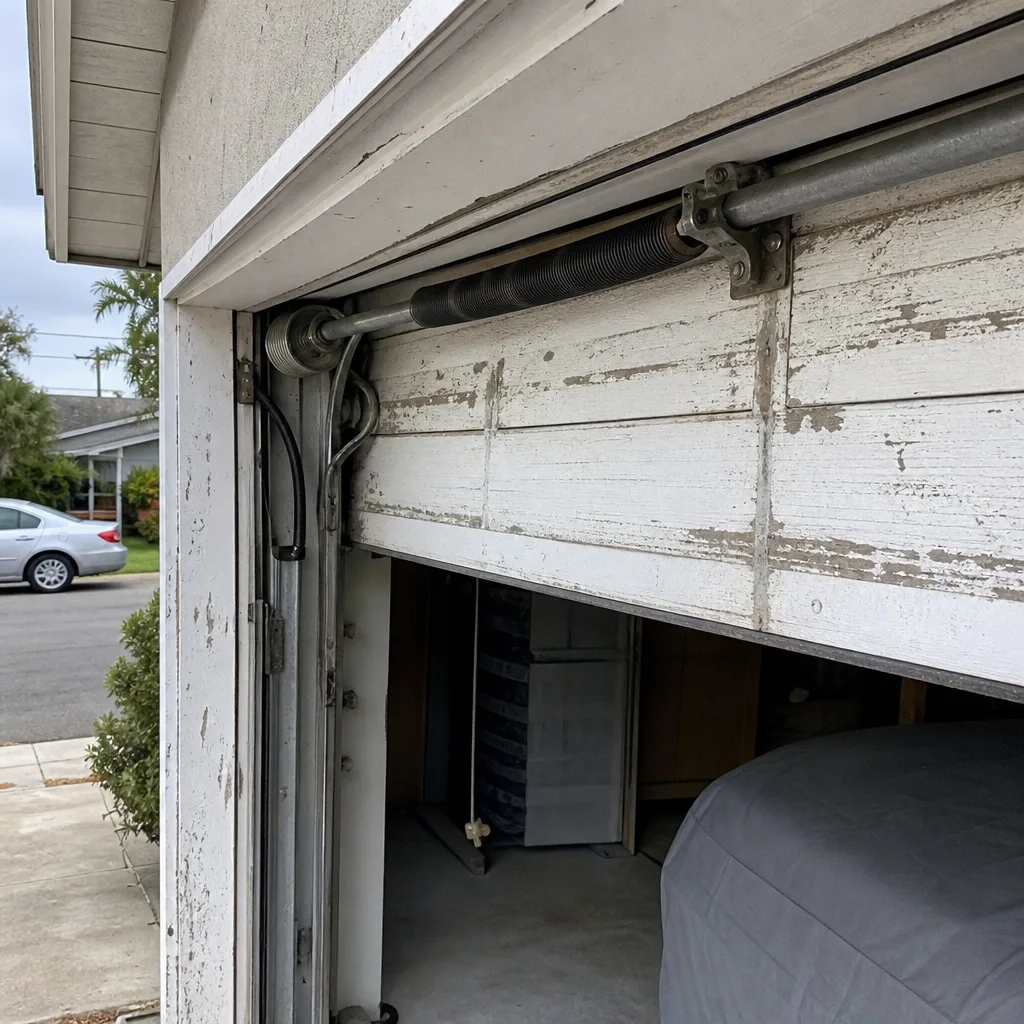
Torsion springs are mounted horizontally on a metal shaft directly above the closed door. You’ll see one or two thick springs, usually 1.5 to 2 inches in diameter, running parallel to the door header. If your door has one spring in the center or two springs with a gap between them, that’s torsion. These carry the most energy per inch and are the most dangerous to replace. Most homes built in Huntington Beach after about 1990 have torsion systems.
Extension springs hang vertically along the horizontal track, one on each side, parallel to the ceiling. They stretch when the door closes and contract when it opens. You’ll see them attached to cables and pulleys at the back of the track. Extension springs are still dangerous, but the energy is directional along the track rather than rotational. The failure mode is still a projectile, which is why every modern install includes a safety cable running through the center of the spring. Older Huntington Beach homes, especially those built before 1985, often have extension systems.
Here’s the practical takeaway: if you have torsion springs, the list of safe DIY tasks ends at the five items above. If you have extension springs, the safe list is slightly longer, you can sometimes replace the safety cable yourself, but the spring itself is still a pro job. We count spring cycles the way you count tire miles, and we’ll tell you what’s left on yours. Most torsion springs are rated for 10,000 cycles, which translates to roughly 7 to 10 years of normal use in a Huntington Beach household that opens the door 3 to 4 times a day.
The Hidden Cost of a Botched DIY Repair
When a DIY spring job goes wrong, the bill isn’t just for the part. It’s for undoing what went wrong first. We’ve walked into Huntington Beach garages where a homeowner got the spring on but wound it unevenly, and now the door hangs crooked and the tracks are bending. The repair that would have been one spring at one price is now a spring, a track realignment, possibly a roller replacement, and two hours of labor instead of thirty minutes. The most expensive repair we do is the one done wrong the first time.
- Voided opener warranty. Most opener manufacturers, including Genie and Chamberlain, have warranty language that voids coverage if the door was not properly balanced. If your DIY spring job leaves the door out of balance, and then the opener burns out trying to lift it, you’re paying for a new opener out of pocket. That’s a $300 to $500 mistake on top of the original spring cost.
- Track and cable damage. A door that’s out of square pulls unevenly on both cables. Within weeks, one cable stretches and the other frays. The track gets torqued. The rollers wear at an angle. What started as a $200 spring replacement becomes a $600 to $900 repair.
- The premium labor rate. This is the one nobody warns you about. When a tech arrives at a botched DIY job, the first hour is spent undoing your work before the real repair can begin. Every garage door company we know charges for that. It’s not punishment; it’s the reality that working on a misassembled tension system is slower and riskier than working on a clean one.
- Injury co-pays. The average emergency room visit for a garage door spring injury runs into the thousands before insurance. Even with coverage, the co-pay alone usually exceeds what a pro would have charged for the entire repair. And that’s assuming it’s just a forearm and not fingers or an eye.
If you’ve already got a door that won’t open or close properly, a reputable local shop will come look and tell you what’s wrong without charging you an arm. In fact, Otto’s Garage Door home base is a real address in Huntington Beach with a license number you can verify before the truck arrives.
Cost Honesty: When a Pro Call Is Worth It and When It Isn’t
We quote prices on the phone, and we hold that number when we get there. So let’s do the same for this section. Here’s what you should actually pay in Huntington Beach, and where the honest boundary lies.
| Task | Typical Huntington Beach Cost | DIY or Pro? |
|---|---|---|
| Spring replacement (torsion, single) | $180 – $280 | Pro. Always. |
| Spring replacement (torsion, both) | $280 – $400 | Pro. Always. |
| Cable replacement (one side) | $120 – $200 | Pro. Always. |
| Track realignment | $130 – $250 | Pro. Almost always. |
| Sensor alignment | $70 – $120 if you call a pro | DIY. Takes 10 minutes. |
| Lubrication service | $60 – $100 if you call a pro | DIY. $15 in supplies. |
| Weatherstripping replacement | $90 – $150 if you call a pro | DIY. $20 – $40 in parts. |
| Remote reprogramming | $50 – $80 if you call a pro | DIY. Check the manual. |
| Opener replacement | $350 – $650 installed | Pro. Electrical and safety. |
| New door installation | $1,100 – $3,500 depending on style | Pro. Measurement is everything. |
Here’s the cost honesty part. A company that charges you $150 to spray some grease on your hinges and tell you the door sounds better is making margin off your lack of information. We’d rather tell you to do it yourself and call us when something actually breaks. That’s how we’ve kept customers in Huntington Beach for twenty-plus years. But the flip side is real too: you are not going to save money doing your own torsion spring. The parts alone cost $60 to $100 for a quality spring, and the tools you need cost another $50. You’re betting your forearm against maybe $100 in savings. The math doesn’t work.
One more honest number: a written estimate for any job, including Garage Door Installation in Huntington Beach, is free. You don’t have to guess. You can get a real number and then decide.
Huntington Beach Specific Factors: Salt Air, Heat, and Code
Huntington Beach has a climate that treats garage doors differently than inland Orange County. We’ve been working in this city since 2004, and we see the same patterns repeat year after year. Here’s what matters for your DIY decision.
Salt air corrosion. If you live west of Beach Boulevard, your door hardware is exposed to a constant salt mist. Springs, cables, and brackets rust faster here than anywhere else in the county. A galvanized spring that would last 10 years in Fountain Valley might last 6 in Huntington Harbour. Rust doesn’t make a spring more dangerous to replace, but it does make it more likely to snap without warning, and it makes a DIY repair more unpredictable. A rusted winding cone can seize mid-turn, which is exactly when the bar slips.
Heat and spring fatigue. Garage interiors in Huntington Beach hit 110 to 120 degrees in August, even with the coastal breeze. That heat accelerates the metal fatigue in springs. We count spring cycles, not years, but the rate of cycles before failure drops in hot, humid garages. If your garage faces west and gets afternoon sun, your springs are working harder than your neighbor’s.
Permit and code realities. Most garage door spring and cable replacements in Huntington Beach do not require a permit. However, if you’re replacing the entire door or altering the opening, the city may require a permit, and the work must meet current wind load and safety standards. A local pro knows what the City of Huntington Beach building department expects. A DIY door replacement that doesn’t meet wind load requirements for coastal exposure is a liability when the next Santa Ana hits.
Neighborhood norms. In neighborhoods like Edwards Hill, Seacliff, and Huntington Harbour, many homes are on a homeowners association’s radar. Some HOAs have language requiring licensed contractors for certain exterior work. Check your CC&Rs before a major DIY door project. We’ve had customers who got a violation notice for a door that was the wrong style or color. That’s a $500 mistake on top of the door cost.
Common Mistakes to Avoid
- Using the wrong lubricant. WD-40 on hinges and rollers is the single most common mistake we see in Huntington Beach garages. It’s a degreaser, not a lubricant. It cleans off the grease that was protecting the metal and leaves it dry. Use lithium grease on hinges, silicone on rollers.
- Adjusting the spring without winding bars. A screwdriver in the winding cone is a shortcut with one outcome. It slips, the cone spins, and you’re in the ER. Winding bars cost $15 and they’re still not enough to make the job safe for a first-timer. You need the knowledge to know how many turns and which direction.
- Ignoring a slowly failing spring. Springs don’t usually fail silently. You’ll hear a loud bang when they snap, but before that, you might notice the door feeling heavy, opening slower, or the opener struggling. If the opener is straining, the problem is almost never the opener. It’s the door balance, and that means the spring. Address it before it fails at 9 p.m. with your car trapped inside.
- Replacing the opener before fixing the door. We see this every month: a homeowner buys a new opener because the old one is “burned out,” then finds the new one burns out too. The door was out of balance and the opener was doing double duty. Fix the door first, then evaluate the opener.
- Buying cheap aftermarket springs online. A $40 spring from a no-name online seller is rarely the right cycle rating, the right wire diameter, or even the right length. A wrong spring means an unbalanced door, which means a damaged opener and tracks. A pro-installed spring from a reputable source is rated for your specific door weight and cycle count.
- Ignoring rust until it fails. In Salt air neighborhoods, rust on cables and brackets is a countdown. If you see rust blooms on your cables, they’re losing strength. Don’t wait for the snap.
When to Call a Professional
Call a pro when the spring is broken, when a cable has come off the drum, when the door hangs unevenly or won’t stay in place when halfway open, when the track is visibly bent or out of square, or when you hear grinding that lubrication doesn’t fix. Also call when the door is stuck open in Huntington Beach at night and you can’t secure your home, which happens more often than anyone wants to admit. Otto’s Garage Door offers free estimates in Huntington Beach; call (714) 650-8648 and a live person answers. If you’ve got a written estimate from another company, bring it over and we’ll give you a second opinion at no charge. That includes Garage Door Opener in Huntington Beach work, where a wrong diagnosis is common and a second set of eyes saves you hundreds.
Frequently Asked Questions
In Huntington Beach, replacing a single torsion spring typically runs $180 to $280, and replacing both springs runs $280 to $400, including labor and parts. Extension springs are usually slightly less. The exact price depends on the door’s weight, spring wire diameter, and cycle rating. Call (714) 650-8648 for an exact quote; estimates are free.
No. Torsion spring replacement carries a significant risk of serious injury, and even experienced DIYers misjudge winding counts, which leads to an unbalanced door and further damage. The safe DIY boundaries are lubrication, weatherstripping, sensor alignment, remote reprogramming, and minor cosmetic repairs. Anything involving the spring or cables should go to a trained professional.
Standard springs are rated for 10,000 cycles, which translates to 7 to 10 years for most Huntington Beach homeowners who open and close the door 3 to 4 times per day. Salt air west of Beach Boulevard, high heat in uninsulated garages, and heavier doors can shorten that lifespan. When a spring snaps, it should be replaced in pairs, since both have the same wear.
If the opener is straining, the problem is almost never the opener. It’s almost always the door balance, which means the spring has lost tension or is failing. An opener is designed to move a balanced door, not to lift 200 pounds on its own. Call a pro before the spring fails completely and the door drops.
If your door is functional but worn, lubrication and weatherstripping add more value per dollar than a full replacement. If the door is rusted through, dented, or the panels are delaminating, a new door returns a significant portion of its cost in curb appeal in Huntington Beach neighborhoods where buyers notice. A free estimate helps you decide with real numbers.
Call Otto’s Garage Door at (714) 650-8648. A live person answers 24/7, including at 9 p.m. when a spring lets go and your vehicle is sealed inside. We quote the job on that call and hold that number when the truck arrives. Same-day service is available for spring and cable repairs in most Huntington Beach neighborhoods.
The Bottom Line
A garage door is a surprisingly simple machine with a surprisingly dangerous energy storage system. The line between DIY and pro isn’t about skill or pride; it’s about whether the task involves tension. Lubricate, seal, align sensors, reprogram remotes. Leave springs, cables, and track work to someone who does it daily. In Huntington Beach, the salt air and heat make these systems wear faster than inland, so the question isn’t if you’ll need service but when. When that day comes, you’ll want a name you can verify, a number that gets answered, and a price that doesn’t change at the door. That’s what we’ve been doing since 2004.
Written by Otto Reinhardt, Owner at Otto’s Garage Door, serving Huntington Beach since 2004.